
SUPERDIVERSITY IN VANCOUVER, CANADA
Mapping Vancouver’s Diversity
Karissa Ketter, Master of Arts in Sociology, University of British Columbia
Vancouver has a reputation as one of Canada’s most diverse cities. Across Metro Vancouver, there are people, events, or buildings that reflect that diversity. Elected in 2022, Mayor Ken Sim, the Vancouver-born son of two Hong Kong immigrants, is the first Chinese Canadian mayor of the city. Diljit Dosanjh held one of the largest concerts in Punjabi outside of India, performing to over 48,000 fans in Vancouver’s biggest area. The Sḵwx̱wú7mesh (Squamish) First Nation are developing Sen̓áḵw, a group of towers for market and non-market homes that will prioritize Indigenous residency. Diversity is not a unique phenomenon for urban port cities, but Vancouver instantiates superdiversity in sociologically important ways.
Superdiversity conveys the multidimensional diversification of global cities. Today, global cities are home to larger numbers of people from a greater variety of backgrounds. Cities have always been a destination for people migrating locally, regionally, or internationally. Superdiversity describes the larger numbers of people arriving from a greater variety of origins that now make cities their homes. Multidimensional diversification refers to how these individuals not only arrive from various origin regions and countries, but they also bring a wide variety of overlapping diversities. The large number of East Asian immigrants to Vancouver, for instance, includes internal diversity of legal statuses, languages, religious commitments, labour market experiences, wealth, genders, ages, and differing access to local services and community networks. The concept of superdiversity provides a framework to understand how diversification processes condition a city’s social patterns and stratification. Introduced by Steven Vertovec, who was attempting to describe the emerging patterns of diversity in Britain and update public perception of immigration and multiculturalism, superdiversity has become a useful tool for describing many global cities: London, New York, Rotterdam, Sydney, and many more.
The People of Vancouver
In what ways does Vancouver showcase superdiversity across its Census Metropolitan Area, Metro Vancouver? The 2021 Canadian census revealed 47% of Vancouverites were born outside of Canada and 55% identified as racialized individuals. While the top three countries of origin for these Vancouverites are China, India, and the Philippines, Vancouver’s immigrants come from all over the globe. A total of 190 languages are used in households across Vancouver: English, French, 26 Indigenous languages and 162 non-official languages. Roughly 44% of Vancouverites’ first language is not English. The most common languages heard in Vancouver—other than English—are Mandarin, Yue (Cantonese), Punjabi (Panjabi), Tagalog (Filipino), Korean, and Iranian Persian. While French is an official language of Canada, it is only spoken at home by 1.6% of people across Metro Vancouver.
In addition to cultural diversity, an important aspect of superdiversity is the opportunities and resources available to visible minorities. Since 2019, racialized workers have increased their presence in almost every sector across Canada by roughly 11%. Even as labour and economic opportunities available to racialized workers are increasing, significant disparities do persist in Vancouver. While the data for Metro Vancouver’s labour market is unavailable, the province of British Columbia reported that racialized workers earn 20–30% less than their White counterparts. Obtaining a city-wide superdiversity of age, class, ethnicity, and gender is a move forward in correcting socioeconomic inequities.
The Neighbourhoods of Vancouver
There are multiple diverse and culturally rich neighbourhoods in Metro Vancouver, and some patterns in where ethnic communities have settled. There are large and concentrated Filipino enclaves in South Vancouver, Richmond, Surrey, and Burnaby. Chinatown rests in the centre of the downtown core, yet more Chinese reside in Richmond. Across the City of Vancouver, there are Irish and Greek in Kitsilano, Poles in Shaughnessy, and Japanese in the downtown core. Little Saigon runs along Kingsway, and Little Italy resides on Commercial Street. There is another concentrated Japanese population in Steveston, and a large Korean population in Coquitlam.
Yet, despite the historic ethnic patterning where communities settle, there are areas where superdiversity shines; groups of all ages, ethnicities, and classes populate stores and parks with diversity of their own. Uptown, New Westminster, is a superdiversity exemplar. Here, the streets are lined with cultural businesses of all kinds. Within half a block, you can eat Japanese or Filipino food, shop for groceries from Europe and East Africa, or drink Ethiopian coffee. The streets are lined with signs in languages including Chinese, Spanish, Japanese, and Amharic.
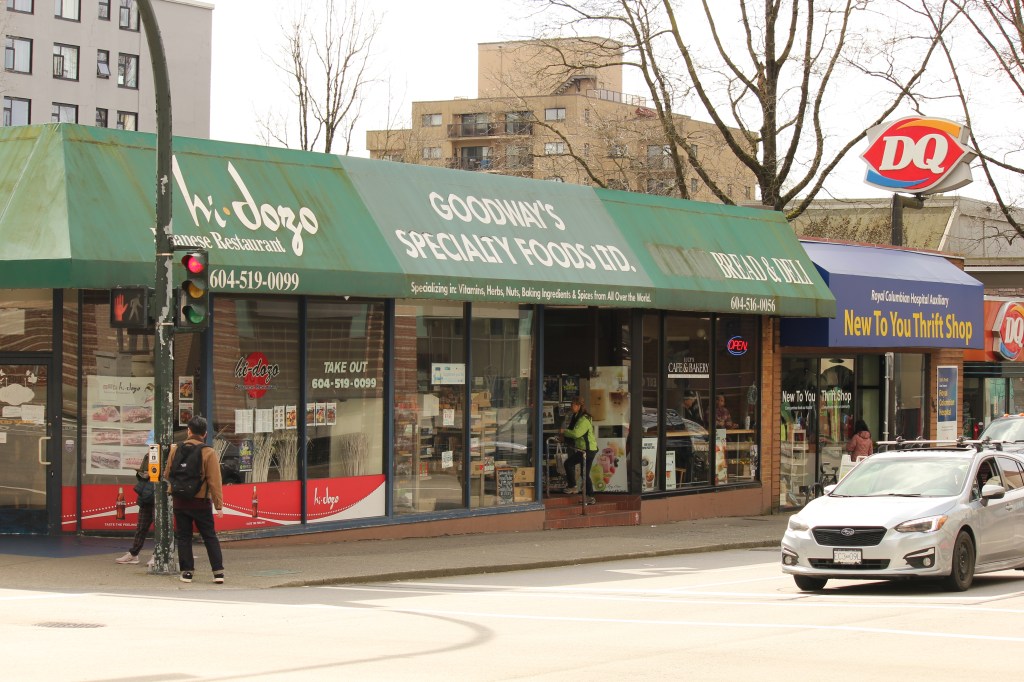
After a quick stroll down the streets of Uptown, it becomes clear the people are just as diverse as the businesses—in age, ethnicity, and class. Older people walk with their grocery shopping to the bus stop; families with young children enjoy ice cream, and a group of high schoolers talk in a parking lot. The people are quick to stop you for a bright conversation. On a warm spring Sunday, the neighbourhood is active and lively; protesters holding signs for Ukraine, women feeding the pigeons, and pedestrians offering change to their unhoused neighbours.
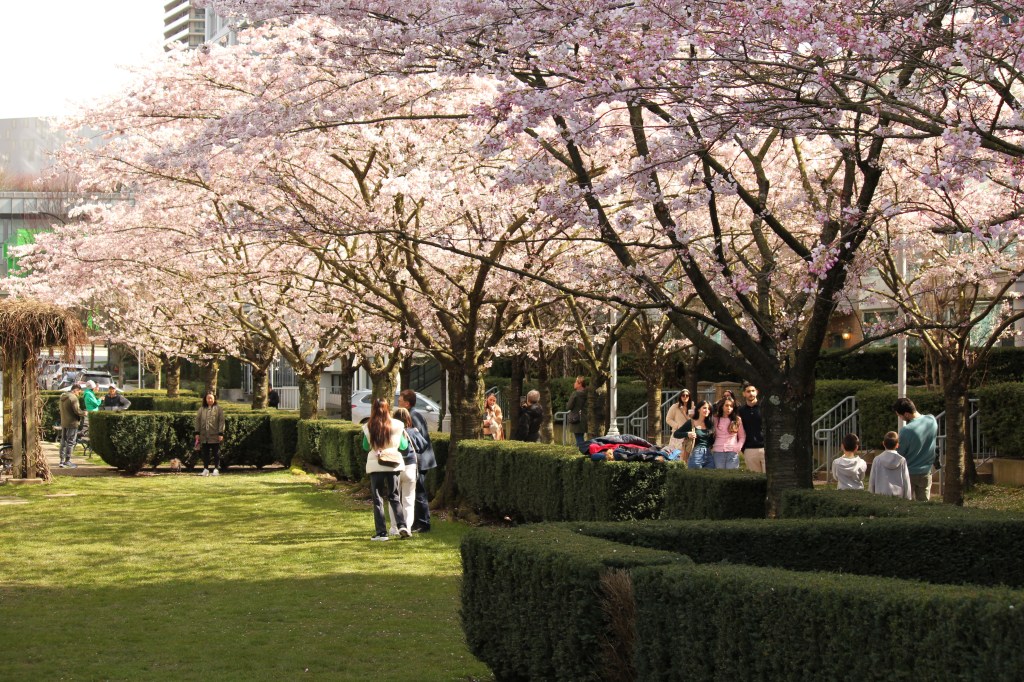
Marpole, Vancouver, is a similar neighbourhood. Painting and art fixtures representing Indigenous history line the streets beneath a collection of restaurants serving Cantonese seafood, Thai, Indian, and locally brewed beer. Heading north, Brentwood, Burnaby is a newly developing neighbourhood that uses art installations to showcase Burnaby’s cultural history. A pillar of icons stands proudly in the centre of Brentwood’s mall to feature a collection of icons like a hockey stick, orca whale, fortune cookie, and cherry blossom. Walking down the block to Madison Centre Park, passing Vietnamese, Japanese, Korean, and Chinese restaurants along the way, reveals a cherry blossom garden that draws in Brentwood locals: families, young couples, and photographers speak in a myriad of languages to admire the flowers with their peers.
In the heart of the City of Vancouver, nestled in English Bay, rests Denman Street. The A-maze-ing Laughter sculptures, made by Beijing-based artist Yue Minjun, lie at the end of See-em-ia Lane, named after settlers from Hawaii and the grandchild of Chief Capilano. Within a few blocks, Persian food, sushi bars, and Irish pubs call people in. Together, these people of all ages, ethnicities, classes, and religions gather to sit in English Bay and appreciate Vancouver’s nature.
While many neighbourhoods across Vancouver share a tolerant and optimistic disposition for community diversity, there is persistent neglect and disdain for areas deemed low-tier. In the Strathcona neighbourhood rests the Downtown Eastside (DTES), one of Vancouver’s oldest neighbourhoods. The community is characterized by the residency of unhoused or ultra-low-income individuals, as well as crime, drug use, and a loss of business in the area. The DTES includes a disproportionate amount of Indigenous Peoples. The Indigenous communities in Vancouver have also experienced an increase in harassment from newly emerging Residential School denialists. The DTES area borders Chinatown, which has also experienced criticism from the community for the crime and deterioration in the area. Mayor Ken Sim sparked controversy in Vancouver over his handling of Chinatown, along with his governance on substance use, homelessness, and housing affordability. In the City of Surrey, a distinctly diverse and racialized city, the rates of experiencing racism and discrimination are up to 55%. The overall discrimination against unhoused and xenophobic racism for community members in Vancouver has increased since the beginning of the COVID-19 pandemic, a phenomenon observed across North America.
The Infrastructure of Vancouver
An important sociological question is how global cities have curated their superdiverse environments. In Vancouver, a partial answer lies in local political governance and urban planning regimes that have contributed to shaping these diverse urban environments. Planners have orchestrated the local infrastructure and community spaces that are needed for social and economic integration, such as housing across types and tenures, neighbourhood houses, and cultural centres, to facilitate socialization. The result was often a move away from ethnic enclaves, as planners guided non-affluent residents to settle across the region rather than in concentrated locations.
Gerald Sutton Brown, the Chief Planner of Vancouver from 1952-1973, oversaw the demolition of Hogan’s Alley for an ambitious new freeway project. The Hogan’s Alley neighbourhood was a predominantly Black and immigrant hub of historic Vancouver that was demolished for the construction of a freeway project that was never completed. Planners forced the residents of this once vibrant Hogan’s Alley and half of Chinatown to disperse across Metro Vancouver. The population was absorbed into the rest of the city.
In the 1970s, the new Director of Planning, Ray Spaxman, ushered in the 1975 Livable Region Plan with the Greater Vancouver Regional District. New political priorities on the city council and the new planning regime changed a great deal of Vancouver’s infrastructure governance. The rest of Chinatown was saved from displacement and demolition. Instead of Sutton Brown’s ambitious and aggressive planning, Ray Spaxman prioritized community consultations and neighbourhood preservation. While this strategy was important for protecting areas such as Chinatown, it also enabled already affluent communities to walk back diversity and growth measures in the new plan. Overall, the superdiversity that is seen today was in some ways enabled by the displacement of ethnic enclaves in the past. As enclaves were shaped and redistributed over time, diversity spread across Metro Vancouver, and new infrastructure was created to facilitate superdiverse stability. Today’s physical infrastructure in Vancouver has enabled diversity across immigration status, race, language, religion, and economic status across nearly all neighbourhoods. The influence of urban planning measures on superdiversity is a question sociological researchers should continue to explore.
What is clear is that the assortment of cultural and ethnic backgrounds of Vancouverites today is reflected in the physical infrastructure. Vancouver has expanded to house 31 cultural centres across Burnaby, Coquitlam, the Township of Langley, New Westminster, North Vancouver, Richmond, Surrey, the City of Vancouver, and West Vancouver. These centres work to create space and communities for racialized and first-generation Canadians. Cultural centres are organizations that create community gatherings based on a shared ethnicity or heritage identity. They hold cultural events as non-profit businesses, not museums or places of religious worship. To name a few, the Musqueam Cultural Centre, Latin American Cultural Centre, Korean Community Centre, Italian Cultural Centre, and an incoming Filipino Cultural Centre. These cultural centres have collectively held numerous events, including promoting community socializing through cooking, dancing, or book festivals. They also amplify artists by hosting theatre, music, and dance performances. Additionally, Metro Vancouver contains multiple neighbourhood houses—places meant to facilitate cross-ethnic learning, socialization, and resource accessibility. The moral basis for neighbourhood houses rests on welcoming the entire community into a collective “community living room—a place where everyone belongs.” There are 16 neighbourhood houses in Metro Vancouver, including the Kitsilano, Mount Pleasant, Collingwood, and Burnaby Neighbourhood Houses. They facilitate important community building for superdiverse cities. This physical infrastructure reflects efforts made by both community members and urban planners to shape how residents are able to experience their environment and facilitate superdiversity in Vancouver.
The History of Vancouver
Immigration and diversity have been defining features of Vancouver for generations. Yet, economic opportunities and the quality of life available to those racialized minorities are a newly established pattern. Vancouver had been home to ancestors of the Sḵwx̱wú7mesh Úxwumixw (Squamish Nation), xʷməθkʷəy̓əm (Musqueam), and səlilwətaɬ (Tsleil-Waututh) First Nation for over 8,000 years before European settlers arrived in 1791. Immigration pathways have changed dramatically over Canada’s history. At the end of the 19th century, waves of immigrants from Germany, Ireland, and Ukraine were drawn to Vancouver for the Gold Rush, to escape political strife, or to establish farms at the encouragement of the Canadian government. European immigration was favoured by federal policy. Yet, numerous immigrants from China came to Vancouver to build the transcontinental railroad, and settled after its completion, establishing Chinatown, despite the federal Head Tax in 1885 effort to dissuade settling. Many Italians also settled in Vancouver to work on the railroad and established Little Italy in the Strathcona area.
Migration patterns began to change in the early 20th century. Punjabi Sikh immigrants from India settled in Vancouver after serving in the British Expeditionary Army during the Boer War. The vibrant Black community in Vancouver blossomed in Hogan’s Alley for its proximity to the Great Northern Railway station. In the early 20th century, Canada discouraged immigrants from China, Japan, and India following an increase in Japanese workers in British Columbia and a subsequent surge of anti-Asian hatred. After the Second World War, Canada’s Prime Minister Pierre Trudeau changed federal immigration policies to cease favouring European immigrants and opened the country up for waves of immigrants from China, India, South Korea, the Philippines and Vietnam—including post-war refugees, war brides, and their children.
Opportunities for economic mobility and social acceptance were still low for racialized Canadians during this time. Asian and Indigenous Peoples were subjected to official segregation, and other non-White Canadians experienced social and economic discrimination.
In 1988, Canada became the first country to legally solidify a multiculturalism policy in federal legislation. The Multiculturalism Act promoted economic and social participation, protected cultural heritage, and espoused intercultural respect. Yet, xenophobic hatred maintained a presence in Vancouver, in more subtle ways.
Anti-Asian and anti-Black hatred persists in the city into the 21st century. Canada has one of the highest proportions of international students, and they face a large share of the hatred in Vancouver, commonly blamed for the housing affordability crisis and low employment opportunities. New regulations to cap student and temporary worker permits have successfully reduced immigration after many Canadians have called for a reduction in immigration.
Federal and provincial policies have encouraged diverse immigration and cultural tolerance, shaping Canada’s identity as a multicultural and tolerant country. Vancouver and Toronto specifically take on this identity as diverse global cities. Communities, businesses, and social opportunities for racialized minorities are thriving. Racialized minorities can and do occupy all levels of economic society in Vancouver.
The Future of Vancouver
Superdiversity in Vancouver is taking root. The people are diverse in age, class, ethnicity, immigration status, and religion. Yet, the diversity is not siloed or isolated by infrastructure or socialization. Rather, the diversity of people, religious infrastructure, and cultural businesses has become commonplace; they are ingrained in the social fabric of Vancouver’s identity.
One way to explore this is through the data visualizations developed by Steven Vertovec, Daniel Hiebert and their team. This tool helps us to understand the scale and scope of diversity across Vancouver’s neighbourhoods and to pinpoint superdiversity “hot spots.” Large and ongoing efforts are needed to correct systemic economic inequities and historical injustices. However, the observable phenomenon of superdiversity shines through.
Superdiversity is not the segregated diversity of the early 20th century, nor is it the overly simplistic Canadian slogan on multiculturalism. Superdiversity allows researchers to think about the intersections of diversity in new and generative ways. This can allow sociologists to conceptualize the growing racialization of the population in ways that serve to increase their social mobility and life chances.
 isquaredlab.ca