
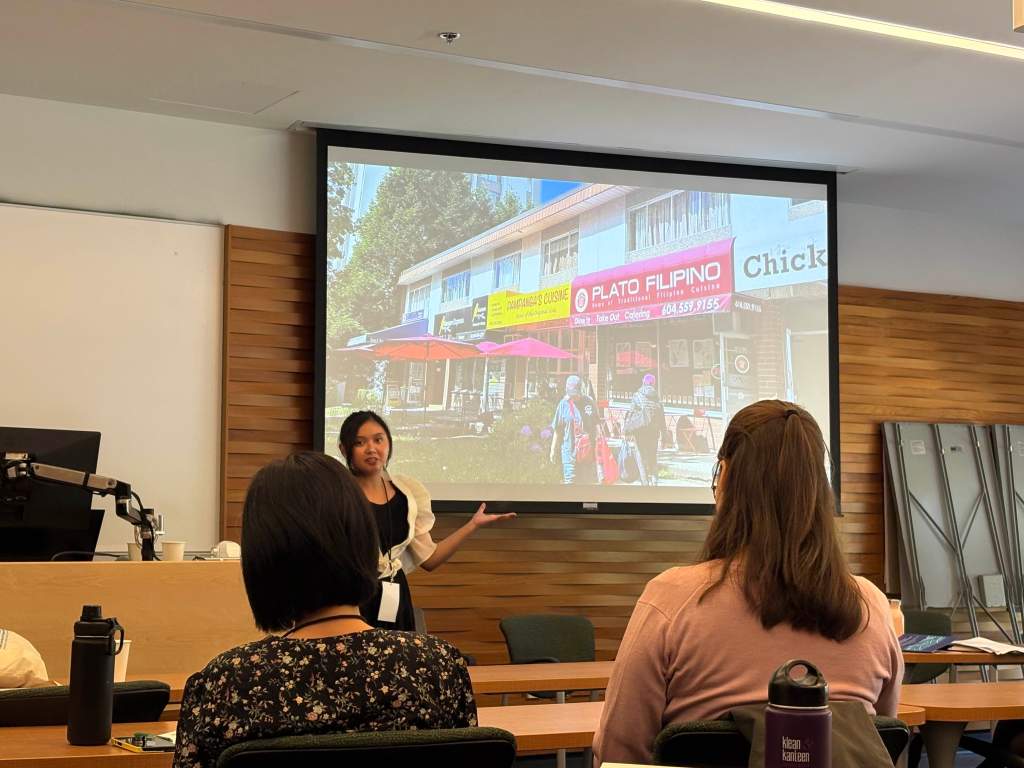
Presentation held at Place and Power: BC Studies Conference 2025
Presenter(s): Gabrielle Abando
Immigrant communities’ social capital stock and generational accumulation have long been explored in the Canadian and BC migration literature. British Columbia’s non-market community and institutional public spaces are forms of social infrastructure bringing people together for network building and inter-generational and cross-cultural resource generation within and outside immigrant enclaves, particularly in metropolitan areas. Co-ethnic capital remains a powerful resource especially for newcomers and racialized immigrant groups experiencing barriers to integration with host society institutions, requiring tighter networks, broader symbols of culture, and cultural repertoire generation through dynamic spaces and power relations conducive to community-building. Focusing on the Filipino Canadian population in BC, this panel examines how this growing immigrant community navigate diverse neighborhoods and cultivate their culinary, theatrical, artistic expressions, and other cultural practices using experiential, autoethnographic, ethnographic, visualization, interviews and other mixed research methods of data collection and analysis. It explores their creative spatial navigation, ethno-cultural cultivation and the possibilities for transformation against the backdrop of how cultural spaces in BC’s major metropolitan area in Vancouver are unequally distributed along racial and class lines.
For more information, please visit BC Studies: https://blogs.ubc.ca/bcsconference2025/
 isquaredlab.ca
Leave a comment